| O brasileiro que é sinônimo de poder em Angola |
| Autor(es): Chico Otavio e Aloy Jupiara* |
| O Globo - 18/12/2011 |
Valdomiro Minoru Dondo, um dos dez homens mais ricos de Angola, amigo de generais e com relação obscura com o poder em seu país, atua no Brasil como exportador e é ligado a policiais e ao jogo. Um dos dez homens mais ricos do país africano, empresário tem, no Brasil, amizades na PF, no samba e no jogo Quando o empresário Valdomiro Minoru Dondo encomendou um bolo gigante, em forma de bolsa Louis Vuitton, a intenção era agradar à mulher, que comemorava 40 anos em festa no Museu Histórico Nacional, na Praça XV. Sem querer, porém, o anfitrião ajudava ali a escrever um pedaço da História de Angola. Naquela noite de novembro de 2008, Agla Dondo não seria a única homenageada. Ao brindar ao casal, os convidados festejaram também a entrada em cena de uma nova elite econômica da África. Gente como os Dondo, que souberam fazer fortuna ao sabor do milagre angolano alavancado pelo petróleo (salto de 0,1% do PIB nos anos 1990 para uma previsão de 10,5% no ano que vem). Filho de imigrantes japoneses, Minoru nasceu no interior de São Paulo. Jovem, mudou-se para o Rio. Mas foi em Angola, após cair nas graças do Movimento Popular de Libertação de Angola (MPLA), partido há três décadas no poder, que ele virou mito. Num país devastado pela guerra civil, enriqueceu tendo como sócias as mesmas autoridades que compram os seus seviços. Ele garante que não está entre os 20 maiores empresários daquele país, mas é modéstia. Minoru é visto como um dos dez homens mais ricos de Angola, lista praticamente composta por generais e outros membros do governo central. Seus negócios, iniciados nos anos 1980, prosperam na mesma velocidade em que correm as histórias sobre a sua obscura relação com o poder, marcada por denúncias de favorecimento, licitações fraudulentas e evasão de recursos. - Intriga de funcionário demitido. Sofremos uma ampla investigação, mas a Inspeção Geral do Estado nos inocentou - disse o empresário. Com mais de 20 empresas em Angola, cinco no Brasil (no ramo de importação e exportação) e residências no Rio, Luanda e Miami, Minoru não gosta de perder tempo em aeroportos. Com cidadania angolana, não precisa de visto em Luanda. É amigo do presidente José Eduardo dos Santos e oferece apartamentos para reuniões ministeriais. No Rio, amizades na Polícia Federal e no mundo do samba lhe garantem regalias e discreta notoriedade. Ao desembarcar, não entra em fila. Há sempre um policial a aguardá-lo. Na quadra da uma escola de samba do Grupo Especial, já foi chamado de patrono. No Aeroporto Internacional do Rio, não é difícil saber quando Minoru está chegando. Basta conferir a presença do agente federal aposentado Aroldo Oliveira Mendonça, sempre pronto a livrá-lo de incômodos do desembarque. Aposentado há três anos, Aroldo entra livremente na área restrita. Ex-dirigente da Unidos da Tijuca, amigo dos diretores da Liga das Escolas de Samba, o agente passou parte da carreira no aeroporto. Hoje, quer ser sócio de Minoru. No ano passado, a Superintendência da Polícia Federal no Rio instaurou processo administrativo disciplinar contra o delegado Rodrigo de Souza Alves e sua mulher, a escrivã Érika Cerqueira de Carvalho. O objetivo era o de apurar as circunstâncias que teriam levado Minoru a custear, em outubro de 2008, a viagem do casal a Angola. Ambos, na época, eram lotados no aeroporto. As passagens e diárias de hotel foram pagas pela Promoangol, holding do grupo angolano VMD, de Minoru. Amigo de Aroldo, Rodrigo frequentou, ao lado de outro delegado federal, Leonardo Tavares, o camarote do agente na Unidos da Tijuca. No banco de dados da PF, consta que Minoru, no período de agosto de 2008 a fevereiro de 2010, entrou e saiu do país aproximadamente 70 vezes, sendo 15 no plantão de Rodrigo e outras 14 no plantão de Leonardo. -- Nos meus plantões, é possível que ele tenha saído da fila, mas o privilégio termina aí - diz Leonardo. Os negócios de Minoru se estendem também a jogos de azar. Há oito anos, uma de suas empresas remeteu 144 máquinas caça-níqueis do Brasil para Angola, por encomenda de outra empresa então de sua propriedade em Luanda, a África Trevo, uma das três autorizadas pelo governo local a explorar oficialmente os jogos de azar naquele país. Ele foi responsável também pelo lançamento da loteria "Raspadinha da sorte" em Angola. Para um país com 37% da população abaixo da linha da pobreza, que figura entre os piores do planeta em índice de desenvolvimento humano, Minoru é um fenômeno. Oficialmente, suas empresas lucraram no ano passado US$90 milhões. Ele atua nas áreas de importação e exportação, fornecimento de bens alimentícios, TI, saúde e fármacos, comunicação, hotelaria e restaurantes, pesca, transporte público, shopping centers, construção e incorporação de imóveis. *do Extra |
Mostrando postagens com marcador África. Mostrar todas as postagens
Mostrando postagens com marcador África. Mostrar todas as postagens
domingo, 18 de dezembro de 2011
Entre Angola e Brasil


quinta-feira, 24 de novembro de 2011
Na era da insegurança alimentar
13. Jornal da Ciência (JC E-Mail)
==============================
Edição 4391 - Notícias de C&T - Serviço da SBPC
==============================
Ao comentar na 'Nature' os 50 anos do Programa Mundial de Alimentos das Nações Unidas, especialistas alertam que a fome pode piorar no planeta caso não se encontrem maneiras de tornar produção agrícola mais produtiva e menos cara.
O mundo das grandes inovações tecnológicas, dos avanços das pesquisas médicas e que já presenciou o envio de homens ao espaço é o mesmo lugar onde 1 bilhão de pessoas dormem e acordam com fome. Na era da corrida pela descoberta da vacina contra o HIV, a desnutrição ocupa o primeiro lugar no ranking dos 10 maiores riscos à saúde e mata mais do que a Aids, a malária e a tuberculose combinadas. O equivalente às populações da Europa e da América do Norte, juntas, está de barriga vazia. E um futuro famélico aguarda a raça humana. Em 2050, apenas por razões ligadas às mudanças climáticas, o número de pessoas sem comida no prato vai aumentar em até 20%.
Os dados são do Programa Mundial de Alimentos das Nações Unidas (PMA/ONU), fundado há 50 anos. Em comemoração a meio século de esforços ao combate à fome, a revista científica Nature desta semana traz um especial sobre o assunto, no qual especialistas alertam: não bastam ações emergenciais. É preciso investir em pesquisas que permitam o desenvolvimento sustentável da agricultura, tornando-a mais produtiva e menos cara. Não é uma missão fácil. A insegurança alimentar está ligada a questões políticas e econômicas, tanto quanto a tecnológicas e climáticas.
"Os somális passaram duas décadas em guerra civil e encaram duas temporadas consecutivas de estiagem. O gado não resistiu e os grãos secaram. Então, agora, eles se veem diante de uma escolha terrível por causa da falta de comida: migrar ou morrer", exemplifica Josette Sheeran, diretora executiva do PMA da ONU, em um texto escrito para a Nature. Clamando que os governantes prometam que as pessoas "não vão morrer sob seus olhos", Sheeran cita o programa brasileiro Fome Zero, lançado pelo ex-presidente Luiz Inácio Lula da Silva em 2003.
"Lula deixou claro que lutar contra a fome seria sua prioridade ao dizer que, se no fim de seu mandato, todo brasileiro tivesse três refeições ao dia, teria cumprido a missão de toda uma vida", recorda. Para Sheeran, o foco no acesso imediato à alimentação aliado a recursos que permitam o desenvolvimento econômico das famílias é uma das opções no combate à fome. "O Brasil era beneficiário do PMA nos anos 1990. Agora, é o nosso nono maior doador."
Biotecnologia - Para o queniano Calestous Juma, diretor do Projeto África de Inovação Agrícola da Universidade de Harvard, a biotecnologia é a chave para a prevenção da fome. Em números de famintos, o continente africano perde apenas para a Ásia e o Pacífico (578 milhões de pessoas), com 239 milhões de desnutridos crônicos. Juma, autor de um livro sobre o tema, lembra na Nature que a tecnologia é fundamental para que os países produzam mais e melhores alimentos, e com menos esforços.
Segundo ele, sem os avanços na área da biologia molecular, as nações africanas "poderiam estar bem pior do que estão agora". Sem a revolução verde, programa mundial iniciado na década de 1940 com o objetivo de produzir novas variedades de sementes, Juma calcula que a produção de grãos em países em desenvolvimento seria 23,5% mais baixa que a atual, e que os preços dos alimentos estariam até 66% mais altos. Ainda assim, não foi o suficiente para evitar um estado nutricional alarmante. "Aliadas ao crescimento populacional, questões relacionadas ao meio ambiente, como a degradação de ecossistemas e a alteração do clima, que leva a períodos mais prolongados de seca, dificultam a agricultura na África", conta Juma, ao Correio.
O especialista de Harvard acredita que as nações africanas devem se abrir mais para ferramentas biotecnológicas, como grãos transgênicos - um assunto ainda polêmico -, adotadas em poucos países do continente. Juma não é contra o uso da terra para o cultivo de outros produtos que não alimentícios, como o algodão, pois acredita que o dinheiro ganho com a venda da matéria-prima pode se reverter na compra de alimentos. O problema, aponta, é que mesmo nesses casos, há pouca exploração da tecnologia. Como exemplo, ele cita os pesticidas contra pragas que atacam os algodoeiros, ainda pouco eficientes na África.
O queniano insiste na necessidade de mais pesquisas científicas visando ao aperfeiçoamento agrícola. Quanto mais variedades de alimentos, diz, menores as chances de se perderem safras. Outra questão importante, segundo ele, é o desenvolvimento de grãos resistentes a doenças. Juma conta que em Uganda, a banana, uma fruta muito consumida pela população local, é ameaçada por uma bactéria que causa mais de US$ 500 mil em perdas por ano. "Não há variedades de banana no país e não há formas para tratá-las quimicamente. Os cientistas ugandenses estão trabalhando no desenvolvimento de uma fruta resistente, a partir de genes da pimenta-caiena." Para o especialista, a cooperação internacional é essencial no combate à fome. "As organizações internacionais precisam expandir o acesso livre a publicações científicas e ao desenvolvimento tecnológico", diz.
Preços - Também convidado a comentar os 50 anos do Programa Mundial de Alimentos das Nações Unidas na Nature, o pesquisador Peter M. Rosset, do Centro de Estudo de Mudanças Rurais do México, declara que o "sistema global de alimentos está falido". Com a falta de controle sobre os preços, a especulação da indústria faz com que alguns alimentos fiquem 300% mais caros, como ocorreu com o milho no México. Rosset é um ativista pelo direito à alimentação e defende que, sem a reforma agrária, a população mundial continuará nas mãos dos grandes produtores.
"Hoje, paga-se mais por um café do que por uma banana", lamenta Rosset. Diferentemente de Juma, ele não acha que são necessárias intervenções biotecnológicas para extirpar a fome. "Pequenos agricultores são muito produtivos e podem usar técnicas ecológicas", diz. Dessa forma, quebra-se a dependência do petróleo e, consequentemente, contribui-se mais para frear as mudanças climáticas, pois ficaríamos menos dependentes de pesticidas e fertilizantes", acredita.
Ameaça à paz - Ontem, o alto comissário para Refugiados, António Guterres, alertou o Conselho de Segurança da ONU sobre a crescente ameaça à segurança e à paz internacional resultante das mudanças climáticas e sua relação com a imigração. Ele mencionou a diminuição das capacidades agrícolas de países em desenvolvimento e a disputa por recursos, como água e terra arável, como potenciais causas de conflito e deslocamento.
Redução da pobreza - Depois do Fome Zero, programa que integra várias ações, sendo a principal delas o Bolsa Família, 26 milhões de brasileiros saíram da linha da pobreza entre 2004 e 2009. Mas a meta de Lula não foi totalmente alcançada: 16 milhões ainda vivem abaixo da linha da pobreza, o que estimulou a presidente Dilma Rousseff a lançar, neste ano.
(Correio Braziliense)
==============================
Edição 4391 - Notícias de C&T - Serviço da SBPC
==============================
Ao comentar na 'Nature' os 50 anos do Programa Mundial de Alimentos das Nações Unidas, especialistas alertam que a fome pode piorar no planeta caso não se encontrem maneiras de tornar produção agrícola mais produtiva e menos cara.
O mundo das grandes inovações tecnológicas, dos avanços das pesquisas médicas e que já presenciou o envio de homens ao espaço é o mesmo lugar onde 1 bilhão de pessoas dormem e acordam com fome. Na era da corrida pela descoberta da vacina contra o HIV, a desnutrição ocupa o primeiro lugar no ranking dos 10 maiores riscos à saúde e mata mais do que a Aids, a malária e a tuberculose combinadas. O equivalente às populações da Europa e da América do Norte, juntas, está de barriga vazia. E um futuro famélico aguarda a raça humana. Em 2050, apenas por razões ligadas às mudanças climáticas, o número de pessoas sem comida no prato vai aumentar em até 20%.
Os dados são do Programa Mundial de Alimentos das Nações Unidas (PMA/ONU), fundado há 50 anos. Em comemoração a meio século de esforços ao combate à fome, a revista científica Nature desta semana traz um especial sobre o assunto, no qual especialistas alertam: não bastam ações emergenciais. É preciso investir em pesquisas que permitam o desenvolvimento sustentável da agricultura, tornando-a mais produtiva e menos cara. Não é uma missão fácil. A insegurança alimentar está ligada a questões políticas e econômicas, tanto quanto a tecnológicas e climáticas.
"Os somális passaram duas décadas em guerra civil e encaram duas temporadas consecutivas de estiagem. O gado não resistiu e os grãos secaram. Então, agora, eles se veem diante de uma escolha terrível por causa da falta de comida: migrar ou morrer", exemplifica Josette Sheeran, diretora executiva do PMA da ONU, em um texto escrito para a Nature. Clamando que os governantes prometam que as pessoas "não vão morrer sob seus olhos", Sheeran cita o programa brasileiro Fome Zero, lançado pelo ex-presidente Luiz Inácio Lula da Silva em 2003.
"Lula deixou claro que lutar contra a fome seria sua prioridade ao dizer que, se no fim de seu mandato, todo brasileiro tivesse três refeições ao dia, teria cumprido a missão de toda uma vida", recorda. Para Sheeran, o foco no acesso imediato à alimentação aliado a recursos que permitam o desenvolvimento econômico das famílias é uma das opções no combate à fome. "O Brasil era beneficiário do PMA nos anos 1990. Agora, é o nosso nono maior doador."
Biotecnologia - Para o queniano Calestous Juma, diretor do Projeto África de Inovação Agrícola da Universidade de Harvard, a biotecnologia é a chave para a prevenção da fome. Em números de famintos, o continente africano perde apenas para a Ásia e o Pacífico (578 milhões de pessoas), com 239 milhões de desnutridos crônicos. Juma, autor de um livro sobre o tema, lembra na Nature que a tecnologia é fundamental para que os países produzam mais e melhores alimentos, e com menos esforços.
Segundo ele, sem os avanços na área da biologia molecular, as nações africanas "poderiam estar bem pior do que estão agora". Sem a revolução verde, programa mundial iniciado na década de 1940 com o objetivo de produzir novas variedades de sementes, Juma calcula que a produção de grãos em países em desenvolvimento seria 23,5% mais baixa que a atual, e que os preços dos alimentos estariam até 66% mais altos. Ainda assim, não foi o suficiente para evitar um estado nutricional alarmante. "Aliadas ao crescimento populacional, questões relacionadas ao meio ambiente, como a degradação de ecossistemas e a alteração do clima, que leva a períodos mais prolongados de seca, dificultam a agricultura na África", conta Juma, ao Correio.
O especialista de Harvard acredita que as nações africanas devem se abrir mais para ferramentas biotecnológicas, como grãos transgênicos - um assunto ainda polêmico -, adotadas em poucos países do continente. Juma não é contra o uso da terra para o cultivo de outros produtos que não alimentícios, como o algodão, pois acredita que o dinheiro ganho com a venda da matéria-prima pode se reverter na compra de alimentos. O problema, aponta, é que mesmo nesses casos, há pouca exploração da tecnologia. Como exemplo, ele cita os pesticidas contra pragas que atacam os algodoeiros, ainda pouco eficientes na África.
O queniano insiste na necessidade de mais pesquisas científicas visando ao aperfeiçoamento agrícola. Quanto mais variedades de alimentos, diz, menores as chances de se perderem safras. Outra questão importante, segundo ele, é o desenvolvimento de grãos resistentes a doenças. Juma conta que em Uganda, a banana, uma fruta muito consumida pela população local, é ameaçada por uma bactéria que causa mais de US$ 500 mil em perdas por ano. "Não há variedades de banana no país e não há formas para tratá-las quimicamente. Os cientistas ugandenses estão trabalhando no desenvolvimento de uma fruta resistente, a partir de genes da pimenta-caiena." Para o especialista, a cooperação internacional é essencial no combate à fome. "As organizações internacionais precisam expandir o acesso livre a publicações científicas e ao desenvolvimento tecnológico", diz.
Preços - Também convidado a comentar os 50 anos do Programa Mundial de Alimentos das Nações Unidas na Nature, o pesquisador Peter M. Rosset, do Centro de Estudo de Mudanças Rurais do México, declara que o "sistema global de alimentos está falido". Com a falta de controle sobre os preços, a especulação da indústria faz com que alguns alimentos fiquem 300% mais caros, como ocorreu com o milho no México. Rosset é um ativista pelo direito à alimentação e defende que, sem a reforma agrária, a população mundial continuará nas mãos dos grandes produtores.
"Hoje, paga-se mais por um café do que por uma banana", lamenta Rosset. Diferentemente de Juma, ele não acha que são necessárias intervenções biotecnológicas para extirpar a fome. "Pequenos agricultores são muito produtivos e podem usar técnicas ecológicas", diz. Dessa forma, quebra-se a dependência do petróleo e, consequentemente, contribui-se mais para frear as mudanças climáticas, pois ficaríamos menos dependentes de pesticidas e fertilizantes", acredita.
Ameaça à paz - Ontem, o alto comissário para Refugiados, António Guterres, alertou o Conselho de Segurança da ONU sobre a crescente ameaça à segurança e à paz internacional resultante das mudanças climáticas e sua relação com a imigração. Ele mencionou a diminuição das capacidades agrícolas de países em desenvolvimento e a disputa por recursos, como água e terra arável, como potenciais causas de conflito e deslocamento.
Redução da pobreza - Depois do Fome Zero, programa que integra várias ações, sendo a principal delas o Bolsa Família, 26 milhões de brasileiros saíram da linha da pobreza entre 2004 e 2009. Mas a meta de Lula não foi totalmente alcançada: 16 milhões ainda vivem abaixo da linha da pobreza, o que estimulou a presidente Dilma Rousseff a lançar, neste ano.
(Correio Braziliense)
terça-feira, 22 de novembro de 2011
Land: getting more expensive – inevitably
Published: 16 Nov 2011
Posted in:
WorldCrops.com | 16 November

By Gary Mead
News that farmland prices in Q3 2011 on the US Plains rose to record highs ought not be surprising. In the current global context – depreciating values and poor returns for just about every other asset, plus rapidly growing demand for grains, either for food or biofuels – this boom in farmland values is predictable. The bigger question is – how far can the boom go before it turns into a bubble?
The answer is that the tipping point from boom to bust in farmland values is probably still years away. Mark twain summed it up: “Buy land – they’re not making it any more.” Nor is it just the US where farmland prices are booming. In the UK, last year saw an average 12% increase in farmland prices in England, to well above £10,000/acre. In parts of Argentina and Brazil, prime farmland values are already as high as those in the heart of the US Corn Belt.
Yet in other parts of the world, although farmland prices have been rising fast – in Poland and eastern Germany farmland prices doubled in 2010, while in Hungary arable land prices went up by more than 90% during 2000-2010 – prices remain relatively cheap. In parts of Africa and Asia, and some places in East Europe (Russia and Ukraine particularly), land remains relatively cheap. It’s obvious that pension funds and other big-money managers are ‘getting’ the agri-land investment story. While commodities overall comprise a tiny amount of these money managers portfolios – and land investments even smaller – more and more of them are either buying into farmland or thinking of doing so in the near future. In June this year the Danish pension fund PKA (which invests on behalf of around 250,000, mostly public sector employees) said it had invested the equivalent of $33.5m in African agriculture via the Silverland private equity fund. It aims ultimately to increase its overseas farmland investments to around $250 million.
Reliably authoritative information about large-scale private sector investment in farmland is scanty – not least because the scene is changing so fast – but one report that caught our eye was published by the Committee for Agriculture of the OECD in October this year and can be found here. The Oakland Institute in the US also covers ‘land grabs’ in some detail although it tends to be less sympathetic to such investments. The OECD report studied six private funds and what they are up to, and pinpointed that this is just the tip of a (growing) iceberg, commenting: Each of the funds highlighted is emblematic of a large trend which is occurring in agriculture on a global basis; the deployment of institutional capital in the agricultural sector which had attracted investment capital.” But while there is a growing body of opinion that this kind of investment is nasty, aimed at purely “land-grabbing” (and by implication exploiting local people), the OECD report adds something interesting and possibly counter-intuitive: “This development is resulting in the transfer of best practices between regions (Brazil to sub-Saharan Africa) which should ensure the adoption of efficient and sustainable farming practices, increase the volume and improve the quality of crops available for both domestic and exports markets (to generate hard currency) and enhance the skill set and employment opportunities for many in the local populations.”
This investment tendency is just lapping around the shores of the world’s under-developed farmlands right now, but over the next few years it’s going to become an unstoppable tidal wave. If handled right, it should be welcomed. Food output and yields need to rise just to keep pace with demand – and the capacity of the public sector to get stuck in and do that is severely constrained. Pension funds and other big investors have every incentive to ensure that best practices are implemented, if only to protect their investments.
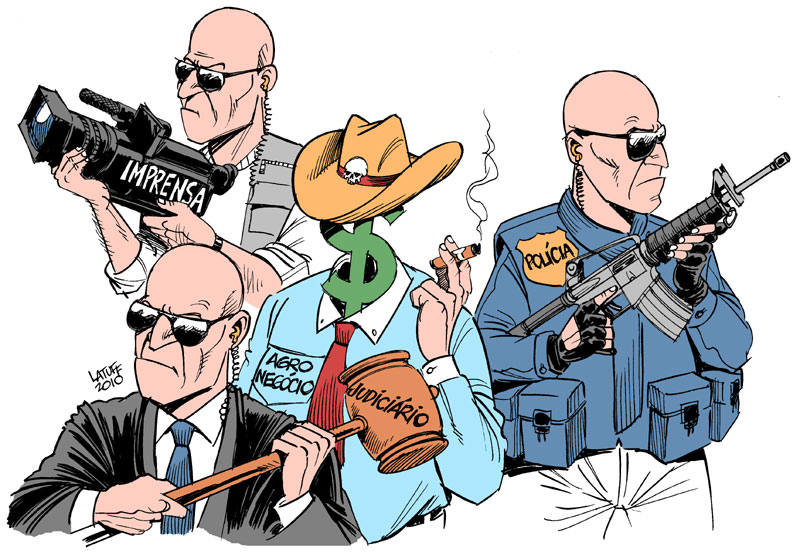
"Brazilian Agribusiness", by Latuff 2010.
By Gary Mead
News that farmland prices in Q3 2011 on the US Plains rose to record highs ought not be surprising. In the current global context – depreciating values and poor returns for just about every other asset, plus rapidly growing demand for grains, either for food or biofuels – this boom in farmland values is predictable. The bigger question is – how far can the boom go before it turns into a bubble?
The answer is that the tipping point from boom to bust in farmland values is probably still years away. Mark twain summed it up: “Buy land – they’re not making it any more.” Nor is it just the US where farmland prices are booming. In the UK, last year saw an average 12% increase in farmland prices in England, to well above £10,000/acre. In parts of Argentina and Brazil, prime farmland values are already as high as those in the heart of the US Corn Belt.
Yet in other parts of the world, although farmland prices have been rising fast – in Poland and eastern Germany farmland prices doubled in 2010, while in Hungary arable land prices went up by more than 90% during 2000-2010 – prices remain relatively cheap. In parts of Africa and Asia, and some places in East Europe (Russia and Ukraine particularly), land remains relatively cheap. It’s obvious that pension funds and other big-money managers are ‘getting’ the agri-land investment story. While commodities overall comprise a tiny amount of these money managers portfolios – and land investments even smaller – more and more of them are either buying into farmland or thinking of doing so in the near future. In June this year the Danish pension fund PKA (which invests on behalf of around 250,000, mostly public sector employees) said it had invested the equivalent of $33.5m in African agriculture via the Silverland private equity fund. It aims ultimately to increase its overseas farmland investments to around $250 million.
Reliably authoritative information about large-scale private sector investment in farmland is scanty – not least because the scene is changing so fast – but one report that caught our eye was published by the Committee for Agriculture of the OECD in October this year and can be found here. The Oakland Institute in the US also covers ‘land grabs’ in some detail although it tends to be less sympathetic to such investments. The OECD report studied six private funds and what they are up to, and pinpointed that this is just the tip of a (growing) iceberg, commenting: Each of the funds highlighted is emblematic of a large trend which is occurring in agriculture on a global basis; the deployment of institutional capital in the agricultural sector which had attracted investment capital.” But while there is a growing body of opinion that this kind of investment is nasty, aimed at purely “land-grabbing” (and by implication exploiting local people), the OECD report adds something interesting and possibly counter-intuitive: “This development is resulting in the transfer of best practices between regions (Brazil to sub-Saharan Africa) which should ensure the adoption of efficient and sustainable farming practices, increase the volume and improve the quality of crops available for both domestic and exports markets (to generate hard currency) and enhance the skill set and employment opportunities for many in the local populations.”
This investment tendency is just lapping around the shores of the world’s under-developed farmlands right now, but over the next few years it’s going to become an unstoppable tidal wave. If handled right, it should be welcomed. Food output and yields need to rise just to keep pace with demand – and the capacity of the public sector to get stuck in and do that is severely constrained. Pension funds and other big investors have every incentive to ensure that best practices are implemented, if only to protect their investments.
Source: WorldCrops.com
Land Grabs and the World Bank
Published: 16 Nov 2011
Posted in:
A farmer in Ethiopia's Ghibe Valley. (Photo: International Livestock Research Institute)
by Joshua Pringle
The United Nations estimates that the global population will grow to 9.2 billion by 2050 (from 7 billion now), 70 percent more food will be needed to feed everyone, and food prices will rise with demand. Climate change threatens to exacerbate the challenge of food production as droughts, fires and floods damage arable land with increasing frequency and magnitude. Thus, fertile land is becoming more valuable by the day.
Public and private investors, both foreign and domestic, are buying or leasing large tracts of fertile land from developing countries in deals commonly referred to as "land grabs." Countries concerned about their own food security, particularly in Asia and the Middle East, are seeking to obtain offshore farms from which to export food crops (often exporting their food insecurity to the country whose land they are utilizing in the process). Private investors see an opportunity to make a large profit by exporting food crops or biofuels, often enticed by tax incentives, low labor costs and giveaway prices. In most cases, the governments selling this land do not consult the local population that has been subsisting off the land for generations. Farmers get kicked off their farms, sometimes compensated, sometimes not.
Since the financial and food crises of 2008, the World Bank Group has incentivized and facilitated land grabs in several countries in Africa, Latin America and parts of Asia. Through its private-sector arm, the International Finance Corporation (IFC), as well as its Foreign Investment Advisory Service and program to Remove Administrative Barriers to Investment, the World Bank has worked to reform land laws and offer tax holidays that attract investors to farmland, while also providing technical assistance and advisory services to the governments of developing countries that are in need of foreign direct investment.
The World Bank claims that it works to help countries overcome inequality and ensure that new land investments offer benefits shared by local populations. Its Principles for Responsible Agricultural Investment (RAI), a list of voluntary principles for investors in agriculture, specifically lays out principles that are meant to protect the food security and natural resources of the public. The World Bank not only fails to comply with its own principles regarding agricultural investment; the Bank's policies actually accomplish the opposite of its stated goals, facilitating land deals that have deleterious effects on local populations.
World Bank Principles
In May 2008, the World Bank responded to the financial and food crises by creating the Global Food Crisis Response Program (GFRP), which led to a 54 percent increase in the next fiscal year in World Bank loans, grants and equity investments. In October 2009, the Bank acted as the central organizer in establishing a multilateral trust fund to support a multibillion-dollar food-security initiative with the G-20. Joan Baxter, a research fellow at the Oakland Institute, notes that, in 2009 alone, the Bank estimates that foreign investors acquired approximately 56 million hectares of farmland—"an area about the size of France"—by long-term lease or purchase in developing countries. "The investment promotion agencies are developing and advertising a veritable smorgasbord of incentives not just to attract foreign investment in farmland, but also to ensure maximum profits to investors. … Investors may pay just a couple of dollars per hectare per year for the land, and in Mali, sometimes no land rent at all."
The Bank has continued to defend the RAI principles that it drafted jointly in April 2010 with the International Fund for Agricultural Development, UN Food and Agriculture Organization, and UN Conference on Trade and Development. The RAI principles encourage, but do not mandate, that existing rights to land and associated natural resources are recognized and respected; investments do not jeopardize food security but rather strengthen it; investments are transparent, monitored and ensure accountability by all stakeholders within a proper business, legal and regulatory environment; all those materially affected are consulted and agreements from consultations are recorded and enforced; and environmental impacts are minimized and mitigated.
None of these standards are being met. Because the principles are not legally binding—and because the Bank, in purporting to hold apolitical status, asserts that securing property rights is a matter to be left to governments—the Bretton Woods project argues that the RAI principles merely "legitimize land grabbing from smallholders."
Ethiopia
In June 2009, a policy brief by the Food and Agriculture Department of the United Nations stated, "The agricultural sector in developing countries is in urgent need of capital," and in order to halve the number of the world's hungry by 2015, "at least $30 billion of additional funds are required annually." It is because of this urgent need, and because an estimated 70 percent of the demand for farmland is in Africa, Baxter says, "that low-income and food-deficit African countries, some still struggling to rebuild after long conflicts, such as Sierra Leone and Liberia, find themselves competing with each other to offer foreign investors ever sweeter deals on their arable land, so desperately needed for local food production." This is also part of the reason why IFC advisory services have resulted in legislative and regulatory reforms that facilitate investor entry in land markets in countries like Sierra Leone, Liberia and Ethiopia.
The Oakland Institute (OI), which has done extensive investigative research in seven African countries where land grabs are taking place (Ethiopia, Mali, Mozambique, Sierra Leone, South Sudan, Tanzania and Zambia), finds that Ethiopia has been the largest recipient of the World Bank's GFRP program. Between early 2008 and January 2011, OI research finds, the Ethiopian government transferred at least 3.6 million ha of land to investors, although the actual number could be higher. "Ethiopia has created a very attractive investment climate in recent years by providing potential investors with various tax breaks, access to affordable land, and a relatively efficient investment process."
Ethiopia is a member of several international agreements that reduce risk for foreign investors, such as the World Bank's Convention on the Settlement of Investment Disputes between States and Nationals of Other States, which details international arbitration procedures for disputes with foreign investors, and the World Bank's Multilateral Investment Guarantee Agency, which insures foreign investors against potential political risks including expropriation and war damages. However, the OI says, "While there is undoubted need for foreign direct investment in Ethiopia, there are widespread concerns that these land investments are not being undertaken in a manner that safeguards the social, environmental and food needs of local populations."
Ethiopians consistently suffer endemic food insecurity and malnutrition. In 2009, some 7.8 million Ethiopians (10 percent of the population) were considered chronically hungry. The Food Security Index for 2010 counted Ethiopia as the sixth most at-risk country out of the 162 countries surveyed. The OI says, "Despite Ethiopia's endemic poverty and food insecurity, there are no mechanisms in place to ensure that these investments contribute to improved food security. In addition, there are numerous incentives to ensure that food production is exported out of the country, providing foreign exchange for the country at the expense of local food supplies."
The Ethiopian government insists that no farmers are displaced by these land deals, that the land being granted is unused—a claim the OI finds blatantly untrue. "In Gambella and Benishangul, respectively, 45,000 and 90,000 households are slated for relocation due to villagization and land investment displacements, resulting in a loss of livelihood for over 650,000 people." Displacement is widespread, and the vast majority of locals do not receive compensation. The government insists that communities are being consulted about land deals, but local populations often don't find out about them until the bulldozers show up.
Forests and wildlife habitats are cleared, and water is used without restriction.
"There is nothing in place to ensure that local people benefit from the business opportunities that these investments could present," the OI concludes. The degradation to the land and "the loss of livelihood are difficult to understate. … Decreased food security, the likely increase in natural-resource-related conflict, loss of self-worth, and erosion of cultural identity are all probably outcomes of livelihood loss. Thus, the adverse impact of land investment on the lives of local people will be dramatic, long term and potentially irreversible."
If the needs of African communities were taken into consideration—not only in Ethiopia, but across the gamut of African land grabs—foreign direct investment could be directed to numerous critical areas, such as the need for roads, schools, health centers, farming equipment and technology, water wells, and general infrastructure. Unfortunately, Baxter says, "Conspicuously absent in the talk about the purported benefits of the land deals is serious discussion of protection of local people, human and environmental health, water resources, biodiversity, human rights, food security, and free prior informed consent of the affected communities."
India
In India, a country where 65 percent of the population is dependent on the land, land grabs have been facilitated by the Land Acquisition Act of 1894, which allows the government to acquire land from landowners by paying a government-fixed compensation. A 1991 World Bank structural-adjustment program reversed land reform that had created laws that kept lands under ownership of the tiller. The 1894 Land Acquisition Act was untouched, thus making it easier for the government to acquire land and sell it to foreign investors.
Vandana Shiva reports, "While land has been taken from farmers at Rs 300 ($6) per square meter by the government—using the Land Acquisition Act—it is sold by developers at Rs 600,000 ($13,450) per square meter—a 200,000 percent increase in price, and hence profits. This land grab and the profits contribute to poverty, dispossession and conflict." Not all the land is being grabbed for agribusiness; some is being bought by investors to build racetracks and expressways. To protect the interests of the POSCO Steel project, India's largest foreign investment, the government has set about destroying as many as 40 farms a day. Nonviolent Indian protestors have been fired at and killed by the government.
Elsewhere
Land grabs are happening in developing countries all over the world: China, Pakistan, Indonesia, Colombia, Paraguay, Bolivia, Guatemala, Honduras. The MERCOSUR countries of Argentina, Uruguay and Brazil have implemented initiatives that regulate foreign purchases of land. But in Argentina, President Cristina Kirchner passed a law that allows foreigners to rent land, rather than buying it, which some argue is even worse because it permits the environmental degradation of agrochemicals and large-scale farming to take its toll without any long-term accountability in place.
Chinese food corporation Heilogjiang Beidahuang State Faros Business Trade Group Co., Ltd. is investing in irrigation systems in Rio Negro, Argentina, in exchange for land rental that it will use to export genetically modified food staples back to China. The Council on Hemispheric Affairs finds, "Chinese irrigation practices are notably problematic, as almost 40 percent of China's total land is plagued by soil erosion. Worried that these practices will be transferred to the Río Negro valley, environmentalists and concerned citizens have begun to protest." As another example of the lack of free, prior and informed consent in land grabs, "The provincial government leased these lands to the Chinese corporation without ever consulting the true owners of the land—the Mapuche."
As the case of Argentina illustrates, governments clearly play a major role in protecting (or failing to protect) the rights and interests of its citizens in these land deals. However, World Bank policies have been these governments' partner in crime, exhibiting blatant disregard for local populations and contradicting the RAI principles the Bank claims to uphold. As long as the World Bank continues to act as an engine for land deals that exacerbate food insecurities of local populations, remove agrarian families from their properties without compensation or informed consent, and result in unsustainable exploitation of natural resources, the Bank cannot claim with any veracity that helping countries reduce poverty and hunger is at the core of its agenda.
Joshua Pringle is a journalist, novelist and singer living in New York City, and is the senior editor for Worldpress.org. He is currently studying international relations in the master's program at New York University.
Source: World Press
Assinar:
Postagens (Atom)